
“I teach a methodology whereby, sitting comfortably for twenty minutes twice each day, one can transcend all of the thoughts of the ‘ever-repeating known’ and experience bliss in the unbounded field of Being.”
— Thom Knoles
For much of my early development, I was drawn to teachers who could help me achieve more.
Jim Rohn introduced me to personal development. Tony Robbins expanded my sense of possibility. Dr Fred Grosse brought greater structure and accountability. Bob Bohlen showed me what extraordinary production looked like in practice.
Thom Knoles introduced me to something different.
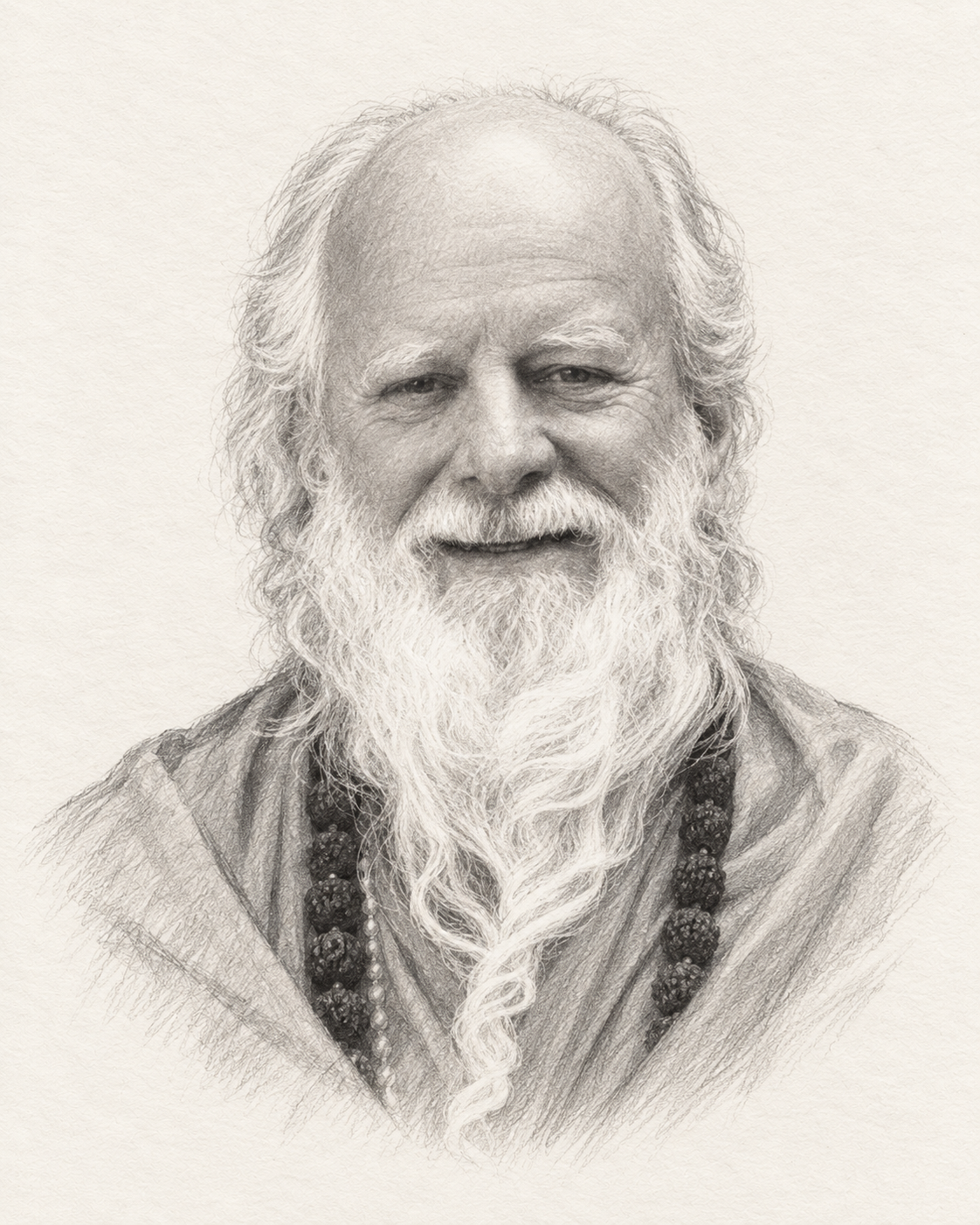
Through a friend, I met Thom in the early 2000s and learnt Vedic Meditation. It was the beginning of a practice I have maintained ever since—regularly, and often twice each day.
Meditation did not replace ambition or action. It gave them another dimension. It began to connect what I was doing in the world with the state of consciousness from which I was doing it.
Learning to meditate
Thom taught me a simple practice: sitting comfortably for approximately 20 minutes, twice each day, using a personally taught mantra.
The technique was simple enough to become part of daily life, but the ideas around it opened an entirely different field of inquiry.
Through Thom, I was introduced to Vedic knowledge, the philosophies explored in the Bhagavad Gita and a tradition of teaching extending back thousands of years.
I attended many of Thom’s courses, talks and teaching sessions. I also spent time with him privately, including travelling to Sydney for one-to-one consultations.
The correspondence that remains shows the continuing nature of that commitment. In July 2019, I flew to Sydney for two private one-hour meetings with Thom on consecutive days and attended his evening teaching, How to Thrive on Change.
When the opportunity was offered, my response was characteristic:
“Lock it in. Where do I meet Thom? Where would be a good place to stay overnight?”
— Scott Banks
I have always believed that if someone has knowledge I genuinely want to understand, distance is not a sufficient reason to miss the opportunity.
Always asking for more
Over the years, Thom taught me progressively advanced techniques and levels of my mantra.
I kept returning and asking what came next. Eventually, after teaching me the highest level available to me, Thom said:
“There is nothing else I can do for you.”
— Thom Knoles, as I remember it
I remember the comment because it reflected my constant desire to keep advancing. I was always looking for the next teaching, the next level or the next piece of knowledge.
Yet perhaps the deeper lesson was that development is not always about acquiring something more. At some point, the work is to live what has already been learnt.
A different kind of evolution
Thom’s teaching began to shift my understanding of personal development.
Until then, much of my learning had been expressed through goals, performance, achievement and measurable progress. Those things still mattered, but meditation introduced me to the distinction between doing and being.
You could spend a great deal of energy telling people what you had achieved, creating an impression or trying to prove something about yourself. Or you could become settled enough in yourself that there was no need to advertise it.
The achievement could remain real without becoming your identity.
This was the beginning of a movement away from needing to impress people. It taught me that there is a quiet confidence in simply being what you have become.
Understatement is not the denial of achievement. It is no longer needing the achievement to speak on your behalf in every room.
Worthy inquiry
One of the most profound ideas Thom introduced to me was worthy inquiry.
A worthy inquiry is not a question asked merely to demonstrate knowledge, defend a position or provoke an argument. It is a genuine question—one you are prepared to be changed by.
That distinction has stayed with me.
Much of life is spent searching for answers, but the quality of the answer is often determined by the quality of the question. A worthwhile question can change what you notice, how you interpret an experience and what becomes possible next.
Worthy inquiry requires curiosity without pretending that you already know. It asks us to listen carefully, suspend certainty and remain open to a deeper understanding.
Established in Being, perform action
Meditation did not teach me to withdraw from life. It taught me to engage with life from a more settled place.
One of the Vedic ideas that has remained with me is:
“Established in Being, perform action.”
To me, this means that effective action does not always need to come from pressure, agitation or the desire to prove yourself. Action can emerge from clarity.
The external work remains: decisions must be made, businesses built, problems solved and commitments honoured. But the internal starting point can change.
This has become increasingly relevant as I think about the next stage of my life. I still want to create, improve and tackle larger challenges. But I want that work to come from alignment rather than noise.
A practice for life
I have now practised Vedic Meditation for more than two decades.
There have been periods when the practice has been more consistent than others, but it has remained a dependable part of my life. Often I meditate twice each day.
Its value is not always dramatic or immediately visible. It appears in the space between an event and my response, in the ability to settle, in clearer thinking and in remembering that I am more than the activity occupying my attention at that moment.
Meditation became one of the few practices that connected every part of my development: business, relationships, health, judgement, creativity and the continuing work of becoming.
What Thom taught me
These are my reflections on what I learnt from Thom and sought to put into practice in my own life.
Being comes before doing
The quality of action is influenced by the state from which it arises. A settled mind can produce clearer, more appropriate action.
Practise rather than perform
Meditation is not something to display. Its value is found in doing it consistently and allowing the practice to influence how you live.
Ask a worthy question
The best questions are not designed to prove what you know. They create the possibility of discovering what you do not yet understand.
You do not need to advertise what you have become
Achievement can be real without being performed for an audience. Quiet confidence comes from being, not presenting.
More knowledge eventually requires embodiment
There is always another idea to encounter, but development becomes meaningful when knowledge is absorbed, practised and lived.
What remains with me.
Thom entered my life after years of learning about goals, achievement, leadership and performance.
He did not ask me to abandon those things. He gave me another place from which to approach them.
Meditation helped pull the different parts of my development together. It taught me that becoming more capable does not always mean becoming louder, busier or more visible. Sometimes evolution is found in becoming quieter, more aware and less concerned with demonstrating who you are.
The paradox is that when you stop trying so hard to appear impressive, you may begin to become something more substantial.
I still want to create, improve and understand what I am capable of. Thom’s influence reminds me that the work is not only to build a different life.
It is to become established within yourself while you build it.
“Thom taught me that personal evolution is not only about doing more. It is also about becoming quiet enough to understand who is doing it—and why.”
— Scott Banks
Continue the journey Artificial Intelligence: A new kind of thinking partner
Scott Banks